
Shelter Isn't Housing - Here's Why That Matters | Our Efforts Week 5
Last week, I introduced you to James. A man who, on paper, qualified for help, but in reality, couldn’t access it. Not because he didn’t want it. Not because help didn’t exist. But because the system required something he didn’t have: stability.
And that’s exactly why approaches like Housing First were created. Because for someone like James, asking him to get stable before giving him housing is like asking him to solve the problem without the very thing that makes a solution possible.
But to really understand why that matters and why the conversation around homelessness can feel so confusing, we need to get clear on something foundational:The difference between shelter and housing.
Once you see that clearly, you start to understand not just Housing First… but also why there’s a growing push in the opposite direction toward what I would call “Shelter First.” And why that tension matters more than most people realize.
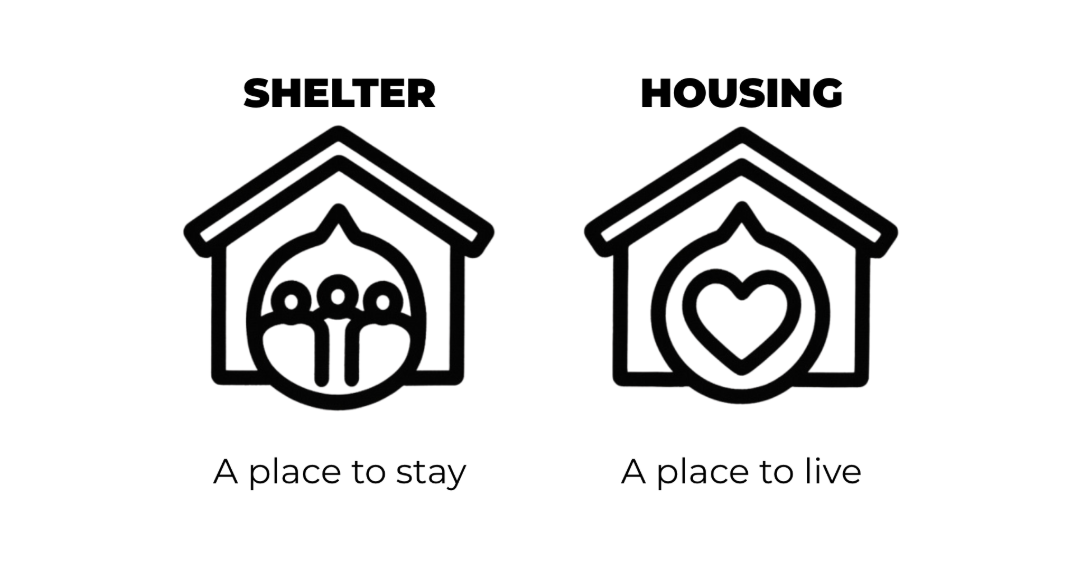
A shelter is a place to stay. Housing is a place to live.
A shelter might offer a bed indoors for the night, sometimes longer. And that matters. It’s safer than the street. It can be a critical first step. But it’s still a shared, temporary environment—often dorm-style, with limited privacy, set schedules, and very little control over your surroundings.
Housing is something entirely different. It’s a place where you have your own space. A door you can close and lock. A bathroom you can use when you need it. A place to keep your documents. A place where someone can reliably find you.
For James, that difference isn’t philosophical. It’s everything. Without housing, he couldn’t hold onto paperwork. He couldn’t keep appointments. He couldn’t build momentum. Everything he needed to move forward required a level of consistency that life on the street and even in many shelters simply doesn’t provide.
That’s why Housing First prioritizes getting people into permanent housing as quickly as possible, with support services offered alongside it.
But not everyone agrees that’s where we should start. There’s a growing argument that before people access housing, they should first go through shelter systems with structured environments where they can stabilize, demonstrate readiness, and move through a more linear path.
On the surface, that might sound practical, but here’s where the distinction between shelter and housing becomes critical. Building shelters to solve homelessness is a lot like building larger waiting rooms to fix a healthcare system.
If more people are sick than there are doctors available, then yes, waiting rooms matter. You need a safe place for people to sit while they wait to be seen. But the actual solution isn’t bigger waiting rooms. It’s more doctors and more access to treatment.
Shelters are the waiting rooms. Housing is the treatment.
Right now, our waiting rooms are full. Across the country, people are sleeping outside because there isn’t enough space inside. That’s a real problem, and we should address it.
But it makes no sense to do that by pulling resources away from the very thing that actually resolves homelessness: permanent housing. And yet, that’s exactly the direction we’re heading.
Within the U.S. Department of Housing and Urban Development funding—the primary federal funding stream for homelessness—there has historically been a strong emphasis on permanent housing solutions. In many communities, 80–90% of Continuum of Care funding has supported housing because the data consistently shows that housing is what stabilizes people.
Now, there are proposals at the federal level to cap how much of that HUD funding can be used for permanent housing—bringing it closer to 30%—and redirect the rest toward short-term shelter, transitional programs, and compliance-based models.
This isn’t theoretical. It’s a real policy shift that’s currently being debated and challenged. In other words, we’re preparing to build more waiting rooms while reducing the number of doctors.
And the consequence is predictable. People who were already housed, already stabilizing, could lose that support and end up back in the system. Back in the waiting room. Back in crisis.
Let me be clear: we do need shelters. I’m not against creating more ways for people to get indoors. But shelters should be a pathway, not a destination.
Take New York City. Because of its “right to shelter” policy, anyone without a place to stay is legally entitled to a bed. In many ways, that’s a remarkable commitment—it’s one of the reasons you don’t see large-scale encampments like Skid Row.
But there’s a tradeoff. When housing is scarce and unaffordable, shelters become long-term holding spaces. People aren’t passing through, they’re stuck. The average stay can stretch well over a year. And the cost of maintaining that system has risen so dramatically that, in some cases, it would actually be cheaper to provide permanent housing.
If we really want to reduce homelessness, we have to stop confusing temporary relief with lasting solutions.
We need waiting rooms, but we also need to remember what they’re for. They’re there to get people to the doctor. And for people like James, the difference between waiting and being treated isn’t just philosophical. It’s the difference between staying stuck… and finally moving forward.
Next week, I’ll wrap this up by talking about "Enforcement first” and how a Supreme Court decision opened the floodgates for policies that prioritize handcuffs and fines over support and resources that are now popping up all across the country.
With Gratitude,
Josiah Haken
City Relief, CEO
