
What If We Need The Poor More Than The Poor Need Us?
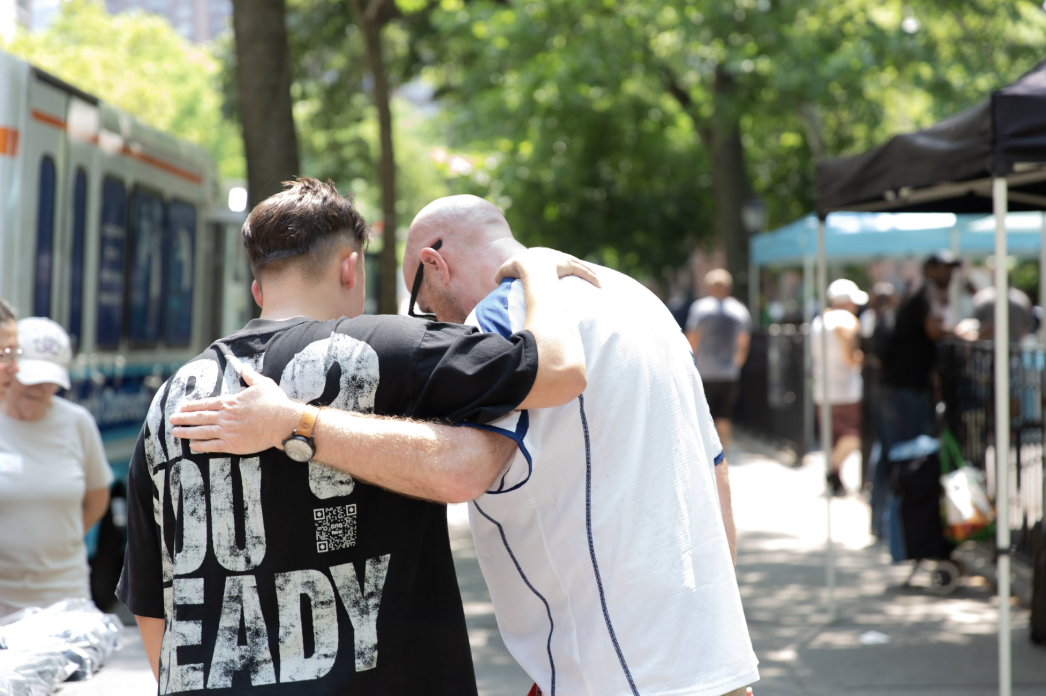
For years, I assumed my role was simple. I had something to offer. People experiencing poverty had needs, and my job was to help.
Then one afternoon in the South Bronx, everything changed.
I met a man sitting alone on a street corner. He was an older African American gentleman with a gray beard and a scar that permanently closed one eye. I offered to bring him a bowl of our famous City Relief soup. He politely declined. I offered him a hot chocolate. Again, he said no.
Running out of ideas, I asked, “Would you like me to pray for you?”
He smiled and replied, “No thanks… but I’d like to pray for you.”
Caught completely off guard, I told him I’d be honored. I sat beside him as he quietly prayed Psalm 23 over me. He finished with these words: “…and I will dwell in the house of the Lord forever.”
I was instantly struck by the beauty of that moment. A homeless man who slept beneath the stars was speaking the deepest words of stability and belonging over my soul.
Those words have never sounded the same to me since.
That day, I arrived believing I was bringing God to someone living on the streets. Instead, I had a divine encounter of my own.
I recently saw The Odyssey with my family, and it reminded me of one of the oldest themes in storytelling: the stranger you overlook may not be who you think they are. In Homer’s epic, the gods often appear disguised as ordinary travelers, revealing the true character of the people they encounter.
Scripture echoes something remarkably similar. Hebrews tells us not to neglect hospitality because some have “entertained angels without knowing it.” Then Jesus raises the stakes even higher. In Matthew 25, He says that whatever we do for one of the least of these—one hungry person, one stranger, one vulnerable neighbor—we do for Him.
I can’t prove the man who prayed over me that afternoon was an angel. But I am convinced he was one of God’s messengers in my life.
For the last fifteen years, one question has refused to let me go: What if those of us with more than we need financially actually need what the poor have to offer more than they need what we have to give?
Not because people experiencing poverty don’t desperately need housing, healthcare, employment, community, and support. They absolutely do.
But what if, in our desire to help, we’ve overlooked something equally important?
What if people experiencing poverty aren’t simply recipients of ministry? What if they’re also among God’s chosen instruments of ministry? What if, through them, God wants to reveal something about Himself that we might not discover anywhere else?
Richard Galloway, the founder of City Relief, has said for years, “The poor are not a problem to be solved, but a portal to the heart of God.” I’ve come to believe he’s right.
From Genesis to Revelation, Scripture reveals a God who consistently moves toward the vulnerable. Then, in Jesus, He does something even more remarkable.
He becomes one of them. One of us.
Before God, every one of us comes empty-handed. We are all poor in need of grace. Perhaps that’s why Jesus says that whatever we do for one of the least of these, we do for Him.
Maybe ministry among people experiencing poverty isn’t simply about bringing Jesus to others.
Maybe it’s also about meeting Jesus there.
If this idea resonates with you, I’d love to invite you to continue the conversation with me on Thursday, August 20, at the Northview Network Missions & Outreach One Day Gathering. From 9:00 a.m. to 3:00 p.m., I’ll be leading a workshop called Wide-Open Doors & Well-Worn Sidewalks: Becoming the Kind of Church That Sees, Welcomes, and Goes at Northview Church’s Student Center in Carmel, Indiana.
If you’re anywhere within driving distance of Indianapolis, I’d be honored if you’d spend the day with us. You can register for free here.
And if you can’t make it, don’t worry. Over the next few weeks I’ll be unpacking many of these same ideas right here in these Friday emails. My hope is that, wherever you are, they’ll encourage you to see your neighbors a little differently.
With Gratitude,
Josiah Haken
City Relief, CEO
